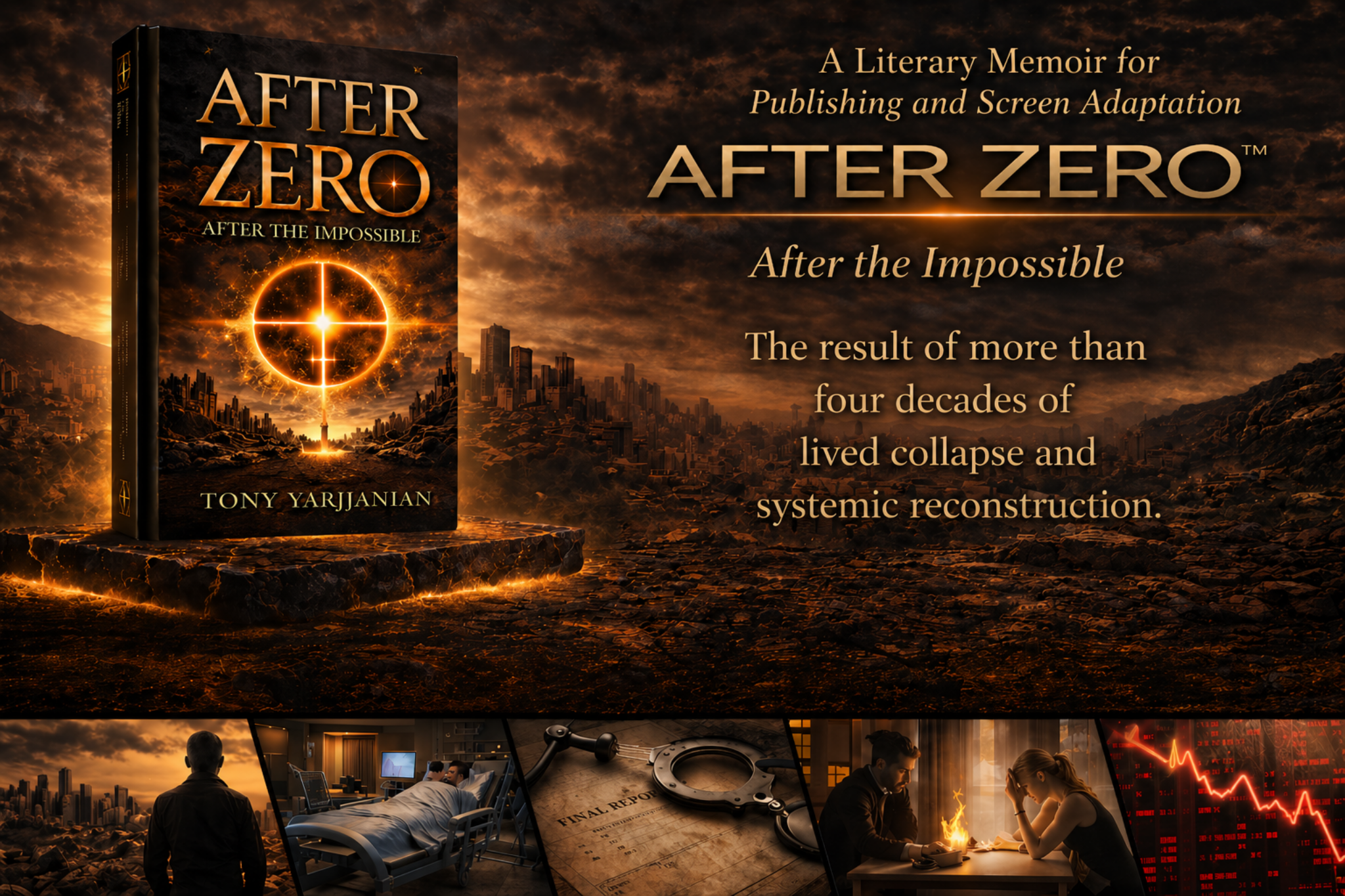
The Manuscript
AFTER ZERO™
After the Impossible
By Tony Yarijanian
AFTER ZERO™ — After the Impossible — is the complete memoir drawn from the documented true story of Tony Yarijanian, written in its full architecture for the first time. The Guinness certification documented the survival. The book documents everything that came after.
The narrative spans forty-six years and five countries — Iran, India, Pakistan, Norway, and the United States — and follows a life assembled across continents before a single morning erased it. The manuscript is structured as sixteen sections (Prologue, fourteen chapters, Epilogue) and treats the 2004 event as one chapter inside a longer architectural arc, not as the story itself.
The voice is restrained, clinical, and unsentimental — built to hold the weight of the material without dramatizing it. Hope and faith appear where they appeared in the experience: as observations from inside the reconstruction, not as instructions to the reader. The result is a memoir that reads not as a story of survival, but as the architecture beneath one — a documented account of how a life is rebuilt across continents, identities, and bodies.
A longer sample is available to credentialed editors and rights professionals through representation.
The manuscript is organized to track the reconstruction architecture rather than chronological survival — anchored at the 2004 event but extending forty-six years across the full international arc.
Section titles are working titles and may be refined in editorial.
The manuscript shares positioning with three contemporary literary works — each rendered with restraint, medical gravity, identity architecture, or cross-cultural scope rather than survival-narrative convention.
For its handling of identity assembled and dismantled across radically different worlds — the structural arc beneath an outwardly extreme story.
For clinical restraint inside catastrophic medical experience — the literary register that holds the weight of the material without dramatizing it.
For the international architecture of identity — a life assembled across continents, with medicine and family as twin structural beams.
Comparative titles are referenced for tonal and structural positioning only. No affiliation, endorsement, sponsorship, approval, or connection with the referenced authors, publishers, or estates is implied.
The category in which AFTER ZERO™ does not belong is as important as the one in which it does.
The manuscript opens at the architectural coordinate, not the moment of catastrophe. The 2004 event is one chapter inside a forty-six-year arc that began with displacement at twelve and continued across India, Pakistan, Norway, and the United States.
Recovery is what you do when something has been temporarily disturbed. The manuscript documents the other thing — the slow, structural, multi-decade work of rebuilding a life after the conditions that produced the original life have been erased. Twenty-two years inside the hospital system, ongoing, beginning at Grossman Burn Centers and continuing across multiple major medical institutions, is one of the load-bearing arcs the book carries — but the book is not about the medical arc. It is about the architecture beneath all of it.
That positioning is the manuscript's commercial differentiator and its literary claim. It is what allows AFTER ZERO™ to be positioned in conversation with work by Westover, Kalanithi, and Verghese — and not confined to the survival-memoir category that would otherwise be its default.
The manuscript is in active editorial review with literary representation. Editors, foreign-rights professionals, and credentialed industry inquiries are routed accordingly. Direct correspondence with the author is welcomed for context and is held in confidence.
Open to qualified editor and rights conversations through representation. Sample chapters and the full manuscript are available to credentialed editors and rights professionals under appropriate terms.
Contact