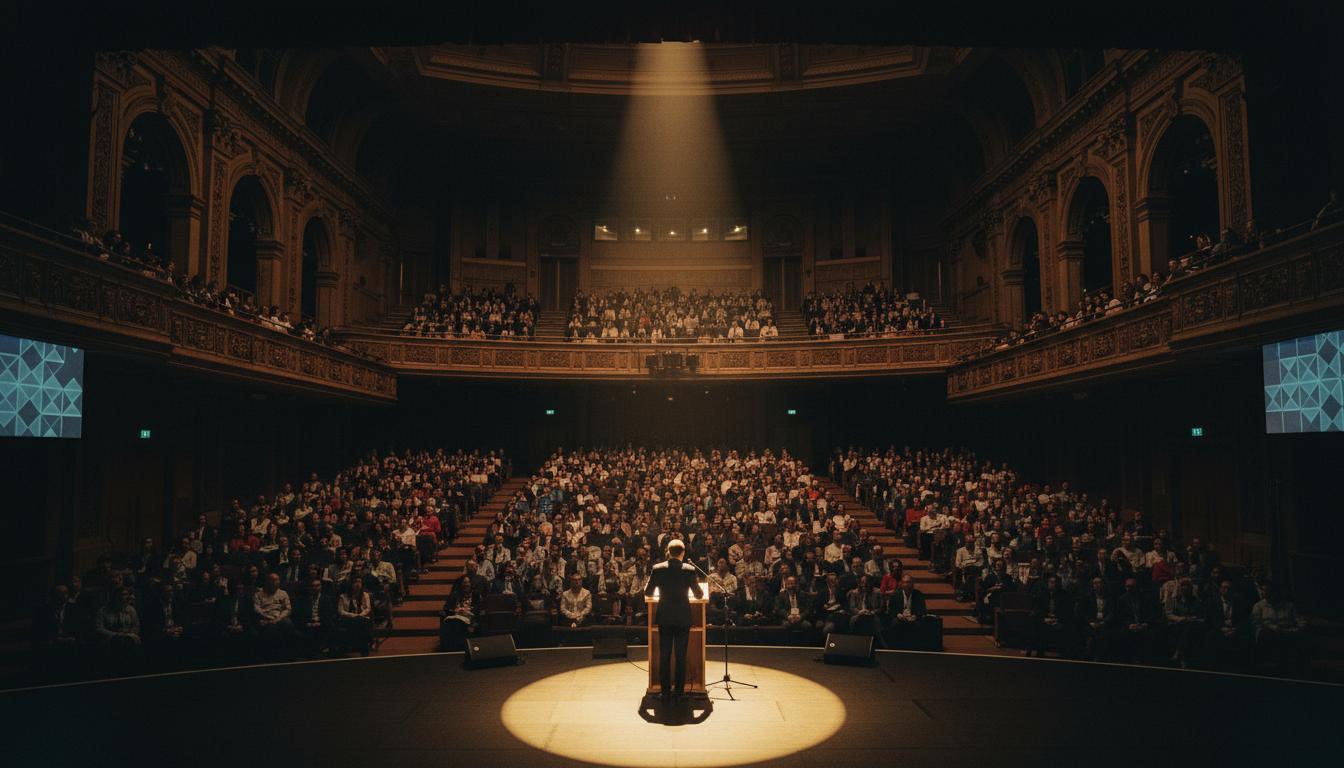
Tony Yarijanian speaks to audiences inside healthcare leadership, executive leadership groups, and risk-and-continuity practices. The case underneath the speaking platform is documentary — acute care delivered at Grossman Burn Centers, certified by Guinness World Records® in 2007, with a reconstructive arc continuing twenty-two years later across multiple major medical institutions.
Each of the three keynote products is a discrete piece of work, built for a specific audience. They are not three runtimes of the same talk. They are three different talks, drawn from one documentary arc.
“When collapse comes, you have two choices: retreat from the world and live inside the question of why, or stand inside the wreckage and begin the work of reconstruction.” Tony Yarijanian
The keynotes are differentiated by audience and structural intent. A healthcare audience is not an executive audience. An executive audience is not a risk-and-continuity audience. The architecture of each talk is built accordingly.
A first-person account of a twenty-two-year clinical arc, told from the patient's side of the bed. The keynote moves through induction, the coma interval, re-entry into consciousness, the structural reality of more than 168 surgical procedures and 60 blood transfusions across the broader medical journey, and the relationship between patient and care team that has not closed in two decades.
Built specifically for healthcare audiences who already know the technical machinery — and who rarely hear what the long arc looks like from the inside. The talk does not flatter the system. It does not condemn it. It records it, with discipline, from the only seat that can.
The flagship keynote. Not a survival story; a reconstruction architecture. After everything has gone to zero, the question is not how to recover — it is how to rebuild a life, a practice, an institution, or a leadership posture from a foundation that no longer exists.
The keynote translates the structural discipline that built Tony's reconstruction into a framework executive leaders can apply to crisis, succession, transformation, and post-failure rebuilds. Delivered without motivational language, without inspirational bromide, and without the rhetorical tropes that characterize the survival-story genre. Executives are not a survival-story audience. They are a reconstruction audience.
Specialized for audiences whose work is the management of catastrophic risk. The keynote takes the audience inside the failure event itself — the day a catastrophic risk became a real one — and then through the twenty-two-year continuity of recovery that followed.
It is not a cautionary tale. It is a study in what the checklist cannot anticipate, and what carries an organization (or a person) through what comes after the worst day on file. Built for rooms that already understand the discipline of prevention and need a different category of input.
The talks are not built on memory alone. They are anchored to a documentary record on four sides. Each pillar is independently verifiable. Together, they form the institutional weight that distinguishes the AFTER ZERO™ platform from the survival-story genre it is often miscategorized into.
Acute care delivered at Grossman Burn Centers following the 2004 explosion. The reconstructive arc that followed has continued across multiple major medical institutions. The clinical record is historical, structurally documented, and ongoing — care continues into the present.
The reconstruction was co-architected. Anahid Yarijanian, RRT, is the central structural figure in the recovery. The family system around her includes a pediatric cardiac ICU nurse and a Physical Therapy Assistant — careers shaped, in part, by the case itself.
The survival was certified by Guinness World Records® in 2007. The certification is independent, verifiable, and on the public record.
A 76,247-word memoir manuscript is in active editorial review with literary representation. A premium limited series adaptation is in development.
This page does not name specific surgical procedures, identify individual clinicians, or describe the operating room in detail. Those elements belong to the keynote delivery itself, not to the public-facing platform. The discipline is intentional. The four documentary anchors are sufficient at this level. The texture is reserved for the room.
Each takeaway is drawn from a documented event in the reconstruction arc — translated into a discipline that audiences can apply at the scale of a team, a function, or an enterprise.
Designed for healthcare systems, executive leadership groups, and risk-and-continuity practices where resilience must move beyond inspiration into reconstruction.
Hospital and nursing leadership, burn medicine, trauma, and rehabilitation conferences — delivered from the rare perspective of a long-arc patient who became an architect of his own reconstruction.
C-suite offsites, founder communities, board retreats, and leadership summits on resilience, succession under pressure, and decision discipline in disruption.
Risk officers, continuity practitioners, safety committees, and insurance, aviation, and industrial leadership focused on the structural dimensions of catastrophic outcomes beyond the operational checklist.
One-sheet, signature talk descriptions, and supporting materials are available on request. Inquiries are answered personally.
Available for select speaking engagements across healthcare leadership, executive leadership, risk-and-continuity practices, and bureau-represented events. Bureau inquiries are answered personally.
Contact